
Some South Woodford scribbles from DD, our resident diarist and observer of all things local
I’m staying at home this month, sitting at my computer, rather than strolling around South Woodford inviting you to share your thoughts on a chosen topic. Essentially, you do my job for me, sharing copy I could never have dreamt up myself. I thought it was time to share a few memories of my own to merit the name of DD’s Diary.
In 1995, the American author, Bill Bryson, published his famous book about England’s endearingly quirky village names: Thornton-le-Beans, Farleigh Wallop, amongst others. I loved it. But decades before that, in my childhood, on our family holidays, we had been looking out for and relishing just the same features of our landscape. Pratt’s Bottom was an obvious favourite. We didn’t go abroad. Just modest little B&Bs in Clacton, Camber Sands, Great Yarmouth, even Eastbourne later on. On one occasion, we were housed in an old railway carriage. Absolutely thrilling. Our suitcases didn’t have wheels then. Nor did we. A car came later. We travelled by train.
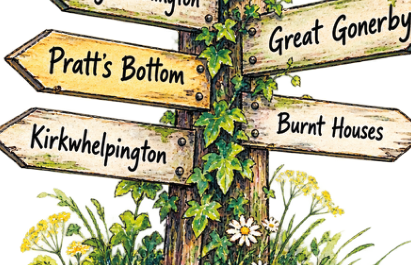
Driving down from the Scottish borders recently, I was reminded vividly of those days when passing a signpost to Dry Doddington. Inevitably, we wondered if there was a Wet Doddington nearby, on higher ground perhaps. Not a place likely to attract holiday-makers, I suppose, although in the heatwaves we had been experiencing this year, perhaps it might have sounded enticing. We were still pondering on that when into view came the signpost to Great Gonerby. I couldn’t help thinking that it might have been better named Gonerby Great! Various signposts referred to Kirkwhelpington, Burnt Houses, Appleton Wiske. Wonderful.
Over a number of years, our own enjoyment in place names, not necessarily quirky or odd, was shared by another local family, and we developed an informal, friendly competition, writing limericks based on our various holiday venues. Back home, we got together to share the results of our poetic endeavours. I thought you might like to see a sample of them.
There was a young pilot from Bangor
Who took a small plane from its hangar.
He flew it quite well
Till he hit the church bell
When he dropped what you might call a clanger.
Amongst my favourites, I’d include this tale of a mini mutiny:
The vicar of Pevensey Bay
Went away for a year and a day.
His flock, off the tether,
Assembled together,
And took a decision to stray.
And, in spite of its rather dubious content, this one was certainly into recycling.
There was a young lady from Blaenou
Who went for a ride on a rhino.
But when it dropped dead
She ungraciously said:
We could use this poor rhino for lino!
A soldier who fought at Culloden
Had to stop when his tootsies got trod on.
And when he got home
He complained with a moan
He was cold and his undies were sodden.
Of course, you will know that there is a long-standing tradition that limericks should often be ever so slightly naughty. We did not shy away from this:
There was a young girl from Prestatyn
Who made herself knickers of satin.
For her classical friends
To peruse as she bends
She embroidered the edges in Latin.
In case you are thinking (quite understandably) that DD wouldn’t dream of such a thing, you’d be wrong. Believe it or not, one of mine was subsequently honoured with an award at the Cheltenham Literary Festival:
A lisping young lady from Hythe
Who tended to wriggle and writhe,
When asked for the reason,
Replied “In the theathon
The men love my wippling thithe.”
Returning to where we started, it occurs to me that the village place names that we now find amusing, like Nasty in Hertfordshire or Crackpot in Yorkshire, Ugley in Essex and Droop in Dorset, are really signposts into our heritage as an island, ‘quaint hangovers from history’. Crackpot’s name derives from the Old English kraka (crow) and the Viking word ‘pot’. I learnt that Great Gonerby has its origins dating back to Saxon times. As you would expect, it’s easy and really rather astonishing, with a bit of research on the web, to track down the origins of the names of every town and village between Land’s End and John o’ Groats.
Someone with a good sense of humour has offered us some thoughts on our very own Woodford. What is Woodford famous for? he asks. And answers: “Woodford is most famous as either the historic London suburb tied to Winston Churchill or as Woodford County, Kentucky, known for its world-class Bourbon. Depending on which Woodford you mean, each has distinct claims to fame.”
I’m wondering if I still retain the limerick technique? Keeping close to home, I’ll have a go. Why don’t you?
A neighbour of mine in Broad Walk
Has taught his pet parrot to talk.
The bird proved so smart
He has mastered fine art
Sketching portraits with pink-tinted chalk.
I’ll be back in the New Year.
MORE INFORMATION
To contact DD with your thoughts or feedback, email dd@swvg.co.uk