
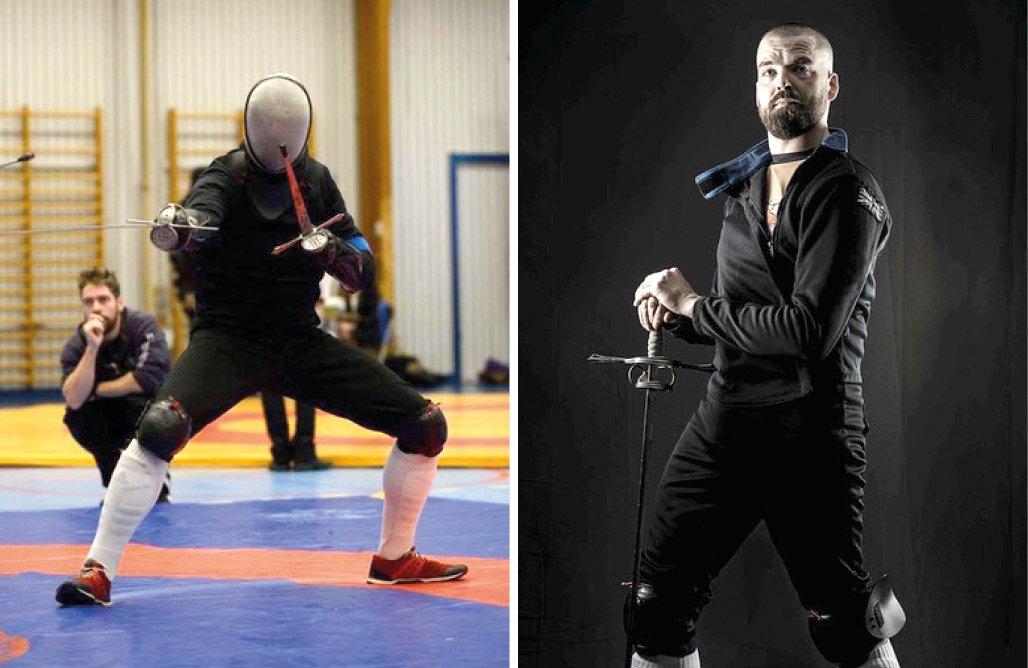
Local resident Jay Maxwell turned a passion for historical swordsmanship into a career, and now offers classes in Woodford dedicated to the study and practice of historical European martial arts
Most people probably don’t expect to meet a professional swordsman at a local networking event. But I was delighted to attend the recent South Woodford Business Network meeting. We all had our stories to tell; mine stems from a passion for sword fighting.
Historical European Martial Arts (HEMA) is the study and practice of how people in Europe fought in the past. Rather than inventing techniques from films or relying on modern fencing traditions, we work from surviving manuscripts that are hundreds of years old.
My father was a history professor with a love of old movies, and I was raised on a diet of Errol Flynn and Basil Rathbone. I first became aware of HEMA around 2004, starting with British traditions of swordsmanship. Soon, I came across the Italian schools of the Renaissance and was fascinated by their elegance and sophistication. What began as an unusual hobby gradually became a serious martial discipline. I spent years studying the old sources, testing their instructions through practical training and eventually competing internationally. During my competitive career, I achieved top-three and top-five international rankings in several disciplines and was selected to represent the UK HEMA community at the 2019 European Games. Eventually, I retired from competition to concentrate on teaching and research.
By this point, I had established Tempus Fugitives. What started as a single school has grown into an organisation across London. I now teach full-time, helping others develop their martial potential. Students come from all backgrounds; some are fascinated by history, some want an unusual way to keep fit; others are actors and stunt performers.
My work has taken me beyond the training hall, as I became involved in motion-capture projects, including both traditional marker-based systems and newer camera-based technology. It is an interesting extension of the same work: taking physical movement and finding ways to reproduce it convincingly, whether for a live performance or a digital character in a game.
For me, that’s what makes historical martial arts so rewarding. You can open a fighting manual written hundreds of years ago, find an instruction that initially seems completely impractical, and then spend hours trying to work out what the author actually meant. Eventually, the answer ‘must’ be demonstrated physically. After more than 20 years, I’m still finding new things in those old books.
Although Tempus Fugitives has students travelling in from hours outside London, I take particular joy in having a small school here in Woodford. There is something satisfying about taking such an obscure interest and turning it into a living activity in the local community.
For more information on Tempus Fugitives and local classes, visit swordfight.club