Ahead of a talk about war memorials in June, Richard Speller, vice-chair of the Woodford and District Centre of the National Trust, offers an introduction to these important symbols of our shared heritage. Photo by Geoff Wilkinson
My interest in war memorials is not a morbid one, that is a fascination with death, nor is it a glorification of war. However, whatever we may think of our country currently, we are probably better off having been on the winning side in the two great wars in the 20th century, and thus, I believe that we owe a debt to those who lost their lives contributing to these victories.
Probably more importantly to me is that they are very much part of our nation’s heritage. Not unlike our parish churches or country houses. Clearly, they are younger, but nevertheless, the vast majority are now over 100 years old. The Imperial War Museum believes there are over 100,000 war memorials across the UK and Eire, but probably less than half of those are listed. Memorials can be checked on their register, and any that are missing can be added if the details are known.
Probably the best-known war memorial is the Cenotaph in Whitehall, where every year the Remembrance Service is held on the Sunday closest to ‘the 11th hour of the 11th day of the 11th month’ when the Armistice was signed in 1918. Interestingly, the Cenotaph, designed by Sir Edwin Lutyens (1869–1944), was first meant to be a temporary structure made of wood. But such was its magnetism with tens of thousands of people visiting that it was converted to stone and made permanent. I should also say it was some years before I learnt that the word Cenotaph is Greek for ‘empty tomb’. Another well-known war memorial is ‘the tomb to the unknown warrior’ in Westminster Abbey. The burial place of a soldier of the Great War “unknown by name, rank or number, laid to rest amongst the monarchs of this country.” So sacred is the tomb that not even the reigning sovereign may walk over it.
Another other important memorial to me is the statue of Nurse Edith Cavell at the top of St Martins Lane near Trafalgar Square, cruelly murdered (not executed as claimed) by the Germans in Brussels in 1915, simply for aiding allied soldiers to escape. However, it was not until the mid-19th century that war memorials, as we know them today, first appeared. These were those honouring the dead of the Crimean War, followed by the Boer War, not a conflict to be proud of! It is, of course, after the First World War (1914–18) that the vast majority of memorials were established. As such a large number perished in that war – probably every family in the land would have lost someone – communities across the country came together and contributed to the establishment of memorials to commemorate lost local fathers, sons and brothers.
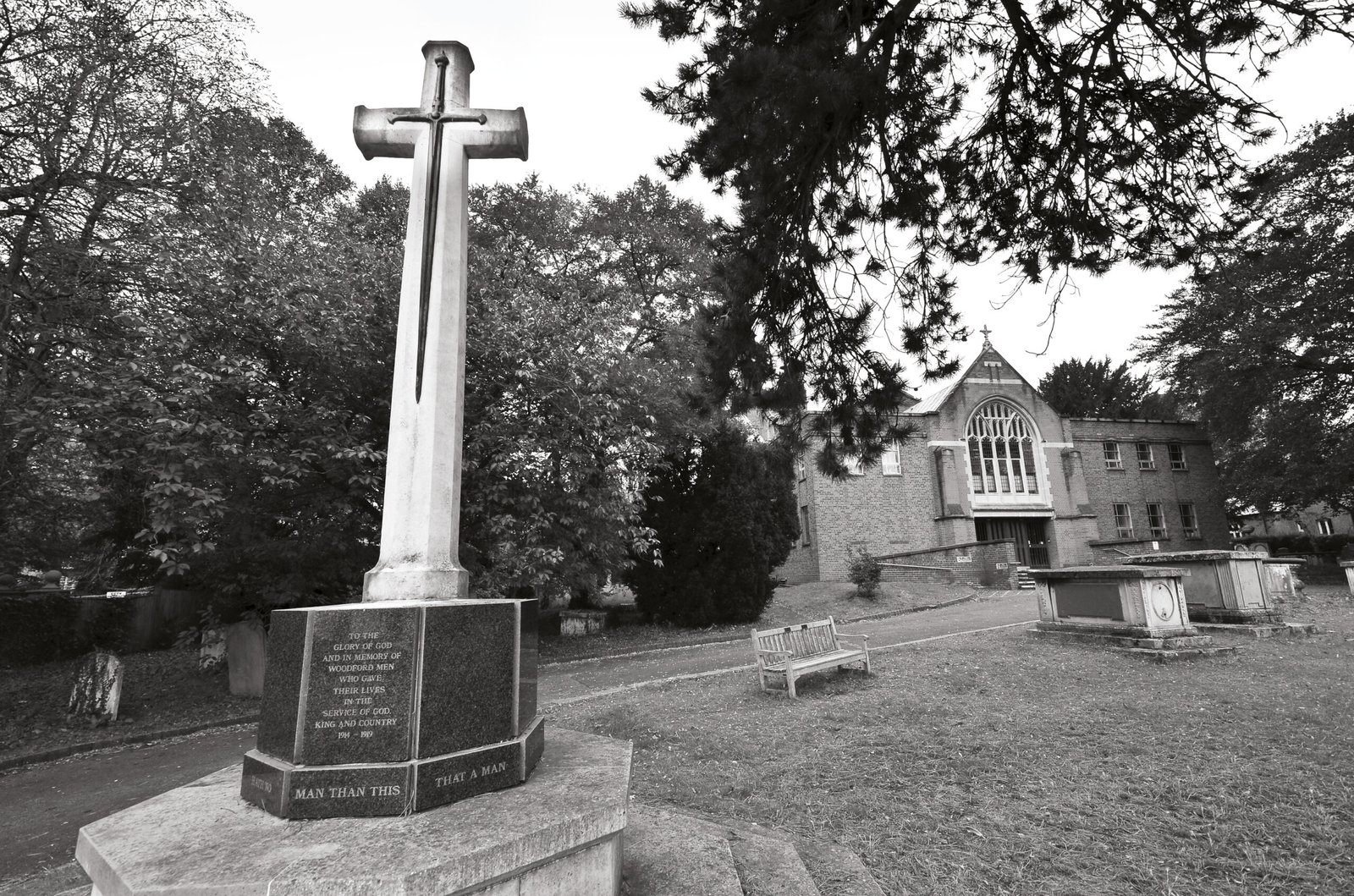
A typical example is the Woodford War Memorial (pictured here) in the churchyard of St Mary’s Church, South Woodford, a Cross of Sacrifice, unveiled in 1920 to commemorate the loss of 73 local men. It stands five metres tall and is made of stone. For a relatively small community, the fact that Sir Reginald Blomfield (1856–1942) designed the memorial here was a real coup. Sir Reginald Blomfield, along with Sir Edwin Lutyens, were the two great World War One architects of so many memorials at home and abroad.
I do believe these memorials should be cherished for future generations, and perhaps an appropriate ending should be the famous and oft-used sayings: ‘Lest we forget’ and ‘Their name liveth for evermore’.
The Woodford War Memorial is located in the churchyard of St Mary’s Church, 207 High Road, South Woodford, E18 2PA. It features the following inscriptions:
To the glory of God and in the memory of Woodford men who gave their lives in the service of God, King and country 1914-1919.
And in memory of those men and women who laid down their lives in the 1939–1945 war, we will remember them.
Greater love hath no man than this that a man lay down his life for his friends.
Richard’s talk will take place at All Saints’ Church hall in Woodford Wells on 10 June from 2.30pm (visitors: £3). For more information, call 07774 164 407