
Editor
Elmhurst Gardens in South Woodford is one of 10 park tennis venues to be renovated as a result of a partnership between Redbridge Council and the Lawn Tennis Association.
“Alongside the investment [of £424,064], Vision RCL will also work with the LTA to deliver a range of activities across the park sites. This will include weekly organised free tennis sessions for all ages and playing levels, where equipment is provided… All courts will be available to book online,” said a council spokesperson.
Visit swvg.co.uk/tennis
The RideLondon cycling event will pass through Redbridge on 28 May, causing some road closures in the west of the borough, including Hollybush Hill, Woodford Road and High Road.
“The event will bring benefits to Redbridge, attracting visitors to local high streets… In the lead-up to the event, we will publicise crowd zone locations where people can view the cycling,” said a Redbridge Council spokesperson.
Visit swvg.co.uk/ride23
The Woodford Arts Group spring exhibition drew large crowds to the Sir James Hawkey Hall in April.
“The exhibition was a great success, with over 300 visitors over one weekend. Some artists put on demos to give visitors an insight into how an artist works, including a print demo by Julia Brett, one on oil painting by Ged Rumak and one on inks and watercolours by Darren Evans. We hope this will be an annual event and look forward to more artists exhibiting next year,” said a spokesperson.
Visit swvg.co.uk/wag
Pupils at Churchfields Junior School in South Woodford planted apple, plum and pear trees in March as part of Redbridge Council’s School’s Tree Planting initiative.
“More than 390 children from the school grabbed spades and got stuck in to plant 10 trees in the school grounds. During the event, the eco-minded pupils also learnt about the important environmental and health benefits trees bring,” said a spokesperson.
The initiative will see pupils help to plant 71 new trees on school sites across the borough this year.
The Department of Environment, Food and Rural Affairs has awarded Redbridge Council £323,774 to fund clean air initiatives and help reduce air pollution in the borough.
“The funding will increase the number of Breathe London air quality monitors across Redbridge while enabling us to develop interactive air quality maps using data gathered by the community. The money will also help deliver cycle training and additional school cycle storage for pupils and parents,” said a council spokesperson.
Wanstead Park’s bluebells have emerged and should remain on show into early May.
“The warmer weather in mid-April encouraged the bluebells to open, and the sunshine brought out their sweet scent. The main show will be at the end of April, hopefully with the flowers on display into May. The park has been very busy with visitors taking photos and children cycling and balancing on the logs. Happily, we’ve seen no sign of destructive trampling so far. The new signage seems to have helped a lot,” said Gill James of the Wren Wildlife Group.
A controversial plan to build two blocks of flats on part of Snaresbrook Station car park has been approved by Redbridge Council.
Developers Pocket Living are due to start the two-year construction project in the spring of 2024, creating 74 homes, all of which will be available to first-time buyers in Redbridge at a 20% discount compared to the local market.
Residents who formed the Real Snaresbrook campaign opposed the development for a number of reasons, including the height of the five- and six-storey buildings.
In the second of a series of articles marking Woodbridge High School’s 85th anniversary year, headteacher Steven Hogan reflects on the school’s history and former headteachers
Woodbridge High School first opened its doors as two separate schools: St Barnabas School for Boys and St Barnabas School for Girls in 1937. The two schools then merged to become the co-educational Woodbridge High School in September 1972, making this academic year the 85th anniversary of schools on the site, and the 50th anniversary of Woodbridge.
The first headmaster of the boys’ school (first called South Woodford Senior Boys’ School, then renamed St Barnabas) was Colonel Branston. All the evidence points to Colonel Branston being a man of strict discipline, who ran the place with military precision. The punishment book tells us the kind of punishment those who crossed him endured: smoking, stealing apples and even a lewd comment on the telephone earned strikes on the hand and the seat from his cane. The first head of the girls’ school was Mrs Rutherford, and we can see far fewer punishments in her book.
The 1944 Butler Education Act had seen the introduction of compulsory secondary education to the age of 15. It also established the tripartite system of education, which for the St Barnabas Schools confirmed their function as secondary moderns. In the school log we can see records of pupils who the school felt could achieve O levels being put forward for 14-plus entry to local grammar schools, such as Wanstead County High.
In 1965, the new boys’ school opened on what had been the school field, and responsibility for the schools passed from Essex to the newly formed London Borough of Redbridge when the Greater London Council was formed. The girls’ school remained in the original building, which had been split into two across the middle, sharing the halls (which are now all carved up) between the two of them.
The 1970s, 1980s and 1990s saw the school work hard to provide the best possible education for young people from the area, despite the reputation gained from being a former secondary modern and having a grammar school in the catchment area. Mr Duke, the famous headteacher from the 1970s and 1980s, who by all accounts was a scary person to meet in a dark alley, was succeeded by Barbara Haigh in the early 1990s. Mrs Haigh began the long journey to improve standards of education and behaviour.
After Mrs Haigh’s retirement in 2002, Andrew Beaumont took over and oversaw a massive expansion of the school from eight-form entry to 10-form, including a new building. I pay tribute to my predecessors for laying the superb groundwork for all that we have been able to achieve since I took over as headteacher in 2018.
Woodbridge High School is located on St Barnabas Road in Woodford Green. For more information, call 020 8504 9618 or visit woodbridgehigh.co.uk
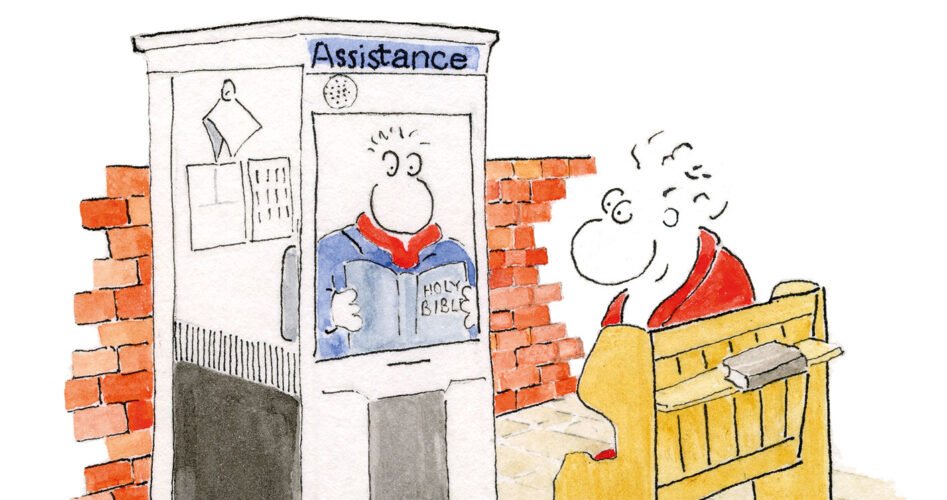
Some South Woodford scribbles from DD, our resident diarist, commentator and observer of all things local. Illustrated by Evelyn Rowland
I was brought up on proverbs. You know the sort of thing: “If at first you don’t succeed, try, try again.” I associate that one with the early stages of learning to knit. Thinking I was getting on fine after 10 rows, until Mother pointed out that I had dropped a stitch in row three. Some proverbs were quite appealing to my imagination but less directly applicable to a small resident of Hillside Avenue in Woodford Green. For example, the one about how useless it is “to shut the stable door after the horse has bolted.”
I saw a proverb in action only last week. I was crossing over from the International Supermarket to the flyover and discovered a cheerful troop of volunteers transforming the half-circle of land at the beginning of Eastwood Road into ‘a mini meadow’. I stopped to admire. “It’s Beth you need to talk to. She’s in charge.” “Yes,” said Beth. “It’s going to be low maintenance, with grasses and wild flowers. Seats for relaxing. A little bit of biodiversity at the heart of things”. I don’t think I’d ever noticed this inconspicuous scrap of land before. But I will now! “We’ve even given it a name,” said Beth. “Eastwood Green.” Yes: “Many hands certainly do make light work.” (Except, of course, in the kitchen, when “too many cooks spoil the broth.”)
It takes a while, years really, to grasp the truth of some of the more surprising proverbs: “The best things in life are free.” Grow a few decades older and you can easily fill a book listing the best things. “If you don’t make mistakes, you don’t make anything.” I’ve found that to be a very useful topic for discussions with grandchildren when the hoped-for A* doesn’t materialise, or when, for once, you don’t get on the podium after the cross-country race. And what about: “It’s better to give than to receive”?A recent poll asking children what they most love about Christmas quite naturally showed a huge majority plumped for “receiving presents”. My partner, David, is a registered speaker on behalf of the charity Mercy Ships, taking first-world surgery to the poorest people on earth. Every member of the workforce on board, from surgeons to deckhands, is a volunteer, even paying a daily charge for board and lodging. But they all say they receive back in fulfilment vastly more than they give.
Two of David’s sturdy, grown-up kids came around yesterday to prove that: “Where there’s a will, there’s a way.” I wanted a large wardrobe moved from the garage bedroom into the big front bedroom. Up a few stairs and along the narrow landing. I was certain it couldn’t be done. They reached the landing. Weighed up the situation. Took the wardrobe to pieces, carried the pieces up the few stairs, and put them together again. As if by magic.
Of course, some proverbs may need updating: “An apple a day keeps the doctor away.” That would have to be one of five apples now. “The grass is always greener on the other side of the fence.” If only there were less concrete and more grass! But some proverbs for families seem to have stood the test of time. “Least said, soonest mended. Avoid washing your dirty linen in public. Never let the sun go down on your anger.” No comment needed, perhaps. When we had that week with the supermarkets running out of eggs, we soon learnt that “it’s the early bird that catches the worm.” I bet you thought I was going to advise you “not to put all your eggs in one basket.”
Procrastination comes in for stern treatment: “The thief of time.” I’m writing this shortly after the New Year when I resolved not to “put off to tomorrow what can be done today.” And failed. But surely “better late than never” is at least a step in the right direction.
When thinking it over, I reluctantly and rather sadly had to agree that “beggars can’t be choosers,” but perhaps I was wrong: not long ago I was passing a fellow citizen seated on the pavement in the rain outside NatWest and asked if I could buy him a sandwich. “Ta, mate,” he replied, “I’ll have a chicken and bacon with salad and mayonnaise on thick-cut granary bread. From Greggs.”
Last Thursday, I decided to visit Alex, the jeweller, opposite Sainsbury’s. I thought: “There’s no time like the present”, “Nothing ventured, nothing gained” and “Hope for the best but prepare for the worst.” He had shown me on a previous visit that “a chain is no stronger than its weakest link.” On this occasion, I hoped to sell rather than buy; some items left to me by a friend. I polished them up nicely. Needn’t have bothered! Alex took one look and reminded me: “All that glitters is not gold.” But, in fact, there was some, and I came away well pleased with our transaction, thinking: “every little helps.” “All’s well that ends well.”
I see that one of my most loved proverbs dates back to the third century BC: “Beauty is in the eye of the beholder.” When you look around at all the shops in South Woodford aiming to make us more beautiful, you can’t help (gratefully) laughing when you know that even the most unlikely-looking people – or so we think – will appear beautiful to someone, and it’s not that the beholder needed to go to Specsavers. Here’s that proverb brought to life in one of my favourite poems, John Betjeman’s In a Bath Teashop (could easily be in a George Lane coffee shop).
“Let us not speak, for the love we bear one another–
Let us hold hands and look.”
She such a very ordinary little woman;
He such a thumping crook;
But both, for a moment, little lower than the angels
In the teashop’s ingle-nook.
I‘ll stop now. “Enough is as good as a feast.”
To contact DD with your thoughts or feedback, email dd@swvg.co.uk
In the first of a series of articles featuring the images of local photographers who document the wildlife of Wanstead Park and the surrounding area, Alessandro Riccarelli presents a montage of his shots of a kestrel in flight
I never used to be interested in photography, although my father made a living out of it. Until my father retired, I never thought I would spend time and money on it as a hobby. But in life, what you don’t find interesting now may well become a future passion!
That’s what happened to me. I love nature, so wildlife photography became my primary interest, although I shoot street scenes and portraits occasionally as well. Recording wildlife is challenging; you don’t know what you’re going to see and when, or if you are going to see anything at all!
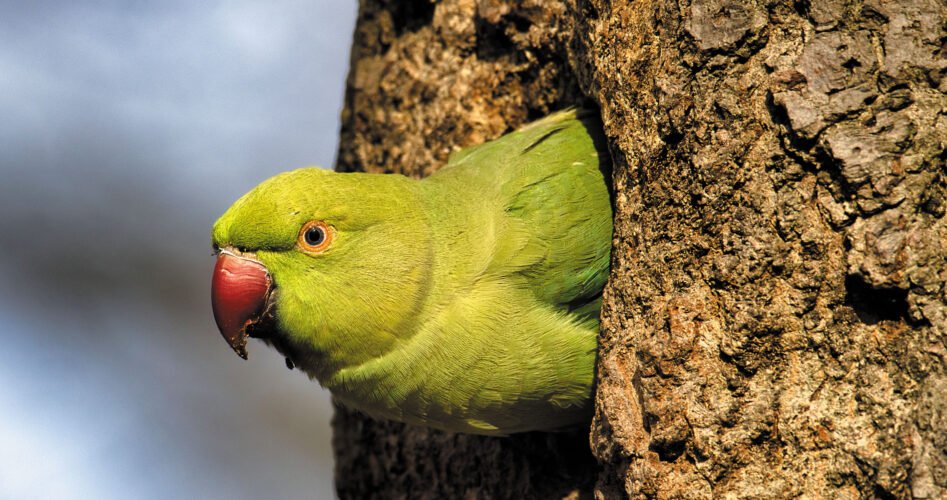
I am based in Gants Hill and like to visit local parks. Wanstead Park and Wanstead Flats are regular destinations. You can see a good variety of species in Wanstead, although unfortunately (for reasons we all know), many have disappeared. Wanstead Park is home to woodpeckers, kingfishers, herons and, of course, parakeets!
Kestrels are also fairly easy to spot, often seen hovering over grasslands hunting small rodents or large insects. Rarely do they miss a catch, so if you notice one diving, wait and you might be able to see something tucked in its talons as it rises. Pointing a camera up a tree with a kestrel perching for prolonged periods can be very tiring, and holding your equipment steady becomes difficult. When this happens, I think about professional wildlife photographers spending days, if not weeks, to get one shot, so I shouldn’t complain about half an hour!
I’m always intrigued by what will happen next and I like challenging situations. Birds of prey don’t have an easy life out there; in fact, just moments after I captured the female kestrel opposite catching her rodent prey, magpies started to chase her, trying to steal a free meal.
I thank the editor for choosing these pictures and I will be taking many more in Wanstead Park, where every outing can be unique.
To view more of Alessandro’s wildlife photos, visit swvg.co.uk/riccarelli
Derek Inkpin from local solicitors Wiseman Lee looks at the concept of private nuisance and reflects on a recent court case which determined Tate Modern’s viewing platform invades the privacy of nearby flats
A 2023 Supreme Court decision (Fearn and others vs Trustees of the Tate Gallery) has highlighted the law in relation to ‘private nuisance’. What’s wrong with the following?
Your neighbour has an adjoining garage to his home which is used for the purposes of a business, where he continually operates noisy machinery.
Your neighbour owns kennels where there is continual barking, preventing you from enjoying the quietness of your home.
Your neighbour has a tree growing in his rear garden close to the flank wall of your house, which causes damage to your property.
The common denominator of these examples is the word ‘neighbour’. Whilst we still cling to the notion that an Englishman’s home is his castle, and that private nuisance protects a person’s use and enjoyment of their land, for a successful claim in tort to be brought for damages and an injunction, there must be a clear, unreasonable use of the land. Nuisance may therefore be caused by inaction on the part of the neighbour, such as escaping water or something which is intrusively unpleasant.
There are three elements of the tort of nuisance, which is either an act or omission, interference or damage. To succeed, a claimant must firstly own the land where they claim their use and enjoyment have been interfered with. However, the blocking of a pleasant view or a TV signal which has caused the nuisance has failed in court.
Whilst each case is judged on its own merits, it is perhaps easy to see that it cannot be predicted with certainty that a court case will succeed where private nuisance is alleged. One-off instances will not be enough but continuous activity that really harms the use and enjoyment of a neighbour’s property will likely succeed. The real problem with private nuisance is the apparent right of the judges to decide each case on its merits, as opposed to a set of concrete definitions of legal principles, which therefore makes it difficult for legal advisers to assist on how a particular case will be decided.
In the recent Fearn case, it was decided the owners of flats which can be seen from the Tate’s viewing gallery succeeded in their appeal where the Supreme Court held that visual intrusion into a home can be considered a private nuisance. Looking from a viewing gallery across the London skyline seems, on first thought, to be a normal enjoyable activity, but not, the court has decided, into someone’s home. However, the Fearn case is not over yet. It has been referred back to the High Court to determine the appropriate remedy. Watch this space!
Wiseman Lee is located at 9–13 Cambridge Park, Wanstead, E11 2PU. For more information, call 020 8215 1000