Some South Woodford scribbles from DD, our resident diarist and observer of all things local. Illustrated by Evelyn Rowland
This month, we are back in the present, enjoying chats together at the shops. That’s not quite accurate, because I’ve invited you to pause and look back on your schooldays.
Thanks, Mike, for recalling your French master. “He was pretty formidable, strict and demanding. I was the dunce at French. I was scared of him. But when I got a B at O level, he congratulated me so warmly. That was the moment when I realised that, actually, he was a great teacher.”
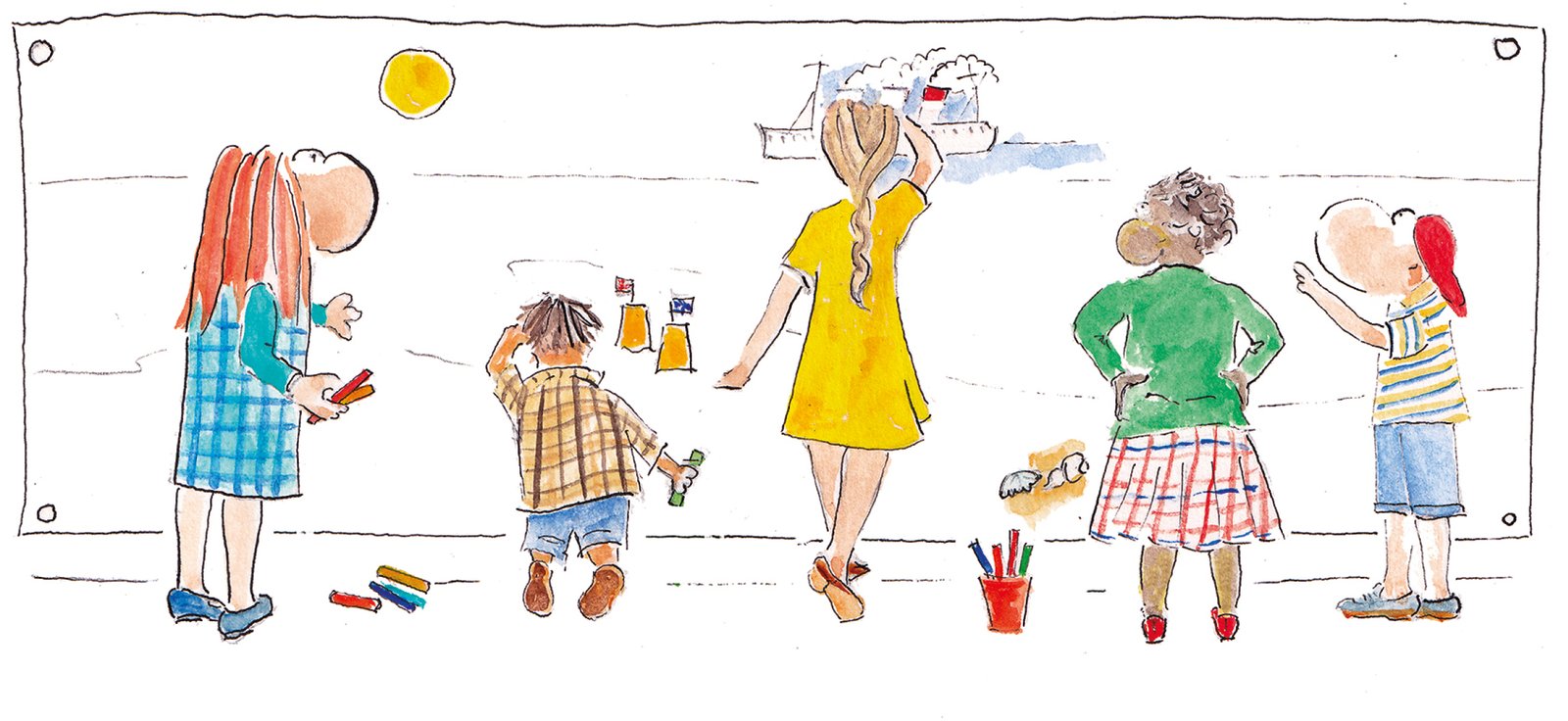
Julia often felt anxious at her primary school. She hated being reprimanded for not trying hard enough. But “I must share a good memory too,” she said: “Our teacher used to fix up a huge empty montage across one wall, just indicating with a few lines the sky, the sea and the beach. We all got going with our coloured crayons to draw things to add to the picture. Seagulls, perhaps, or deckchairs, children building sandcastles. Creating a picture together made us feel like a family.”
Caine went to school in Sussex. “What I really valued most was the core friendship with five or six other boys. We supported each other through any hard times, thoroughly enjoying the good times together. Essentially, sharing the process of growing up.”
Harry was at school in Surrey. He told me how he rapidly changed from History to Geography at O level when the History syllabus seemed to be mostly about learning lists of dates. “Botany was challenging too: I don’t think I ever mastered the details of the sex-life of the male fern. But I did master the role of Hotspur in the annual Shakespeare production. I’ll always be able to recite his speeches. You remember things you learnt by heart as a child.”
Javina was educated at ‘the best school in Delhi’. “You really felt you belonged there. Wearing the school uniform was compulsory. It was certainly unique: the fabric for every item of clothing was woven at the school. At 11 o’clock sharp, we were supplied with a small bottle of milk and four biscuits. I used to smuggle in a tiny jar of coffee from home. I loved blowing bubbles in it with the straw that they supplied.”
Phil went to school in quite a poor district in South Wales in the 1950s. “The school toilets were all outside. On days when they were completely frozen up, the school had to be closed. You can’t believe it, can you! A bitter-sweet event really; you got a day off school, but it often meant missing rounders, my favourite sport.”
Carol beamed. “I loved school. I treated it like a social club. I worked hard at the subjects I enjoyed and winged the rest. The Drama and English departments were terrific. Each class had to write and produce a play and the one adjudged to be best was presented to the entire school. Just the right preparation for me. I was a comedy actress. Acting was my career after leaving school at 16. It was tough. There were barren times, of course, but I loved it. I really wish schools today would attach more importance to music and drama.”
Fred’s primary school teacher, Miss Bryant, gave naughty pupils a smack on the palm of the hand with a ruler. Very naughty ones received a more painful rap on the knuckles. “One day, I was cheeky after a smack on the palm and, for a dare, like Oliver Twist, I asked for more. But I was threatened with the knuckle treatment as an encore and retired quickly to my desk. She certainly was strict, but, true to her reputation, she got me through the 11-plus.”
Susan was whisked away in her imagination from her trolley in Waitrose: “My schooldays were the happiest days of my life. I loved learning. At primary level, it was the three Rs: reading, writing and arithmetic. At high school, I threw myself into everything. I was deputy head girl, captain of rounders and a member of the school tennis and netball teams. I loved Latin. I became fluent in French, Spanish and German. I cried when I left school. As I came out through the school gate, I clearly remember thinking ‘for 15 years, this has been my home, my life.’”
Listening to your stories prompted me to recall a mini sample of mine from my years at Woodford County High School. You’re right: it’s the teachers who were the key characters in our dramas. Nearly all ours were, as was usual then, unmarried. I freely admit that I held all of them in deep, often tender respect. At least two had been engaged to be married, but their husbands-to-be had died in the last months of the 14–18 war. My Classics mistress encouraged me to read Virgil aloud, simply to relish the lilting rhythms of his verse. A wonderfully far cry from education being regarded as a preparation for landing a well-paid job. My French mistress was very young, having recently graduated from the Sorbonne. Thanks to her, I received frequent compliments on my Parisian accent when holidaying in France. I recall dear Miss Leigh one day turning round to write on the blackboard. It was evident she had popped to the loo between classes. Her skirt was caught up in her knickers. We struggled with giggles. But should we alert her before she rejoined the main corridor for the whole population to join the joke? Amongst us girls, Miss Spill, from the Geography department, briefly enjoyed an aura of delicious notoriety when she was serving on the jury at the ‘obscene publications’ trial of DH Lawrence’s novel, Lady Chatterley’s Lover. We wondered how crucial her quietly spoken vote might have been.
Suffice it to say, I emerged from school well supplied with heaps of ‘valuable’ knowledge: to make green, you blend yellow and blue, the hypotenuse is the longest side of a right-angled triangle, the Battle of Hastings was in 1066 and nine times seven is 63.
To contact DD with your thoughts or feedback, email dd@swvg.co.uk